
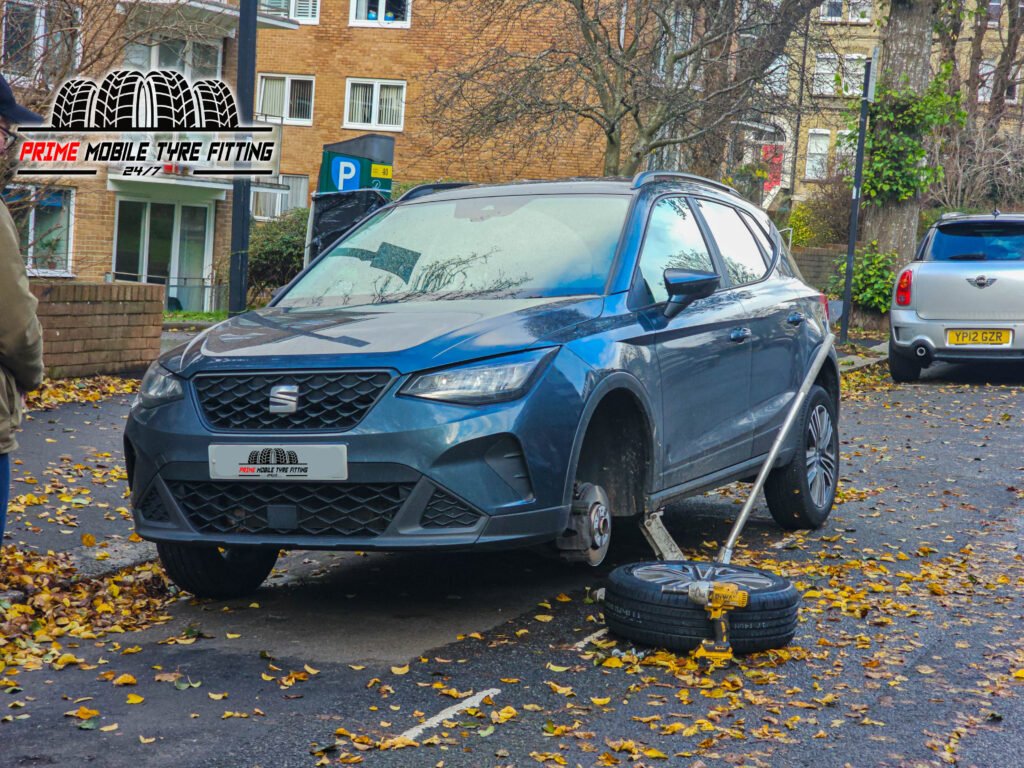
A tyre problem on the A23, outside your home, or in a workplace car park creates one immediate question: do you need recovery, or can the tyre be dealt with where you are? The difference between roadside tyre service vs recovery can mean the difference between continuing your journey in an hour and losing most of the day to a tow, garage booking and further waiting.
For many punctures, flats and blowouts, a properly equipped mobile tyre technician can bring the tyre shop to you. But recovery still has an important place when a vehicle is unsafe to move for reasons beyond the tyre itself. Knowing which option fits the situation helps you make a calm, safe decision when time is tight.
What a roadside tyre service actually does
Roadside tyre service means a trained technician attends your location with the tools, replacement tyres and repair equipment needed to assess and resolve the tyre issue on site. That could be at home before work, on the hard shoulder where it is safe to stop, at a supermarket, on a business premises or beside a stranded van.
The technician will first check the tyre, wheel and vehicle condition. If a puncture is within the repairable tread area and the tyre has not been driven flat or damaged internally, a professional repair may be possible. If the tyre is split, badly worn, has sidewall damage or has suffered a blowout, replacement is normally the safe answer.
A mobile fitting van can supply and fit the correctly sized tyre, balance the wheel where required, set tyre pressures and make sure the vehicle is safe to drive. It can also help where a locking wheel nut key is missing or damaged, which is a common reason a simple tyre change becomes a bigger problem.
The aim is straightforward: fix the tyre issue where the vehicle is, then get you back on the road without asking you to arrange a recovery vehicle and visit a garage afterwards.
Roadside tyre service vs recovery: the key difference
Recovery moves your vehicle from one place to another. A recovery operator may fit your spare wheel if it is accessible, inflated and suitable to use, but their core job is transportation. Once the vehicle reaches a garage, the actual diagnosis, tyre supply and fitting may still need to be arranged.
Roadside tyre service resolves the tyre fault at the location. Rather than towing a car with a puncture to a depot, a mobile technician can often inspect the damage, repair it if it meets safety standards or fit a new tyre there and then.
That does not mean recovery is the wrong choice. It is the right call if the car has collision damage, suspension damage, a seized wheel, an unsafe roadside position, multiple mechanical faults or any issue that makes it unsafe to work on or drive. The important point is that a tyre-only problem does not automatically require a tow.
For drivers in Surrey and West Sussex, this can be particularly useful when a puncture happens before an airport run, during a commute, outside a customer appointment or while a van is needed for work. Avoiding a recovery journey can protect more than your schedule – it can protect your income and commitments.
When a mobile tyre technician is usually the better option
A roadside tyre service is often the most direct solution when the vehicle is otherwise sound and the problem is limited to a wheel or tyre. A nail in the tread, a slow puncture, a sudden flat, damaged valve, worn tyre discovered at home, or a blowout that has not caused other vehicle damage can all be assessed on site.
It is also the practical choice when you have no usable spare. Many modern cars are supplied with tyre repair kits instead of spare wheels, and those kits are not suitable for every puncture. They will not fix a sidewall cut, a large hole or internal damage caused by driving on a flat tyre. Using sealant can also complicate a later repair.
Mobile tyre fitting is useful when your wheels are secured with locking wheel nuts. Without the key, even a recovery operator may be unable to remove the wheel at the roadside. A specialist technician with the appropriate removal equipment can deal with the lock safely, then fit the replacement tyre needed.
For small fleets, the case is even clearer. A van sitting at a recovery depot is a van that cannot make deliveries, reach jobs or serve customers. On-site tyre support keeps disruption to a minimum and gives fleet managers a clearer route back to normal operation.
When recovery is the safer choice
Never choose convenience over safety. If a tyre failure has followed a collision with a kerb, pothole or another vehicle, check for more than visible rubber damage. A cracked alloy wheel, bent suspension component, damaged steering or leaking fluids can make the vehicle unsafe to drive even with a new tyre fitted.
Recovery is also often necessary if the vehicle is in a dangerous or inaccessible position. On a live motorway lane, a narrow blind bend, or a location where there is not enough room to work safely, the priority is getting people out of harm’s way. Follow police, motorway or breakdown-service instructions, move behind a barrier where it is safe to do so, and do not attempt a tyre change in a dangerous area.
You may also need recovery if several tyres are damaged, the vehicle has been driven for a significant distance while flat, or the wheel itself cannot safely accept a new tyre. A professional inspection will identify these issues, but drivers should not assume that a new tyre alone makes a damaged vehicle roadworthy.
Cost, time and inconvenience: what changes?
Recovery can involve a call-out, mileage or destination charge, followed by tyre costs and garage labour once the vehicle arrives. It may be included in a breakdown policy, but cover levels vary. Some policies only recover the vehicle to a nearby garage, and that garage may not have the right tyre in stock or space to work on it immediately.
With mobile tyre service, the call-out and tyre work are handled as one job. Clear upfront pricing matters here. You should know the likely cost before work starts, including the mobile attendance, tyre choice and any additional work such as locking wheel nut removal.
Time is usually the bigger saving. Recovery requires a vehicle to be collected, transported and handed over, then waits for a garage appointment. A mobile tyre technician comes to the car or van with the equipment to complete the tyre work. Availability, traffic, tyre size and location will always affect response times, but removing the transport stage can make a major difference.
There is a trade-off. A fixed garage may carry a wider range of specialist tyres or be better placed for complex wheel, alignment and mechanical work. If you need unusual performance tyres, a rare fitment, extensive alloy wheel repair or suspension investigation, a garage visit may still follow. For the majority of urgent tyre failures, however, the first job is simply to make the vehicle safe and mobile again.
What to do when you get a puncture or blowout
If you feel a tyre deflate while driving, hold the steering wheel firmly, ease off the accelerator and avoid harsh braking. Move to a safe place as soon as possible. Put on your hazard warning lights, keep passengers away from moving traffic and do not continue driving on a flat tyre unless you must move a very short distance to safety.
Once stopped, look for obvious damage only if it is safe to do so. Do not pull out a nail or screw. It may be slowing the air loss, and removing it can make a repair less likely. Take note of your tyre size if you can find it on the sidewall, plus your location, vehicle registration and whether you have a spare wheel or locking wheel nut key.
When you call Prime Mobile Tyre Fitting, explain whether the tyre is flat, visibly damaged or completely blown out, where the vehicle is parked and whether it is a car or van. We can then advise on the safest next step, attend with the right equipment where appropriate and work to get you moving again anywhere, anytime.
Choose the service that solves the actual problem
A recovery lorry is essential when the whole vehicle needs moving. But if the vehicle is mechanically sound and the fault is a puncture, flat or failed tyre, roadside tyre service can remove a costly extra stage from an already stressful situation.
The best decision is not always the fastest-looking one. It is the one that keeps you safe, gets the tyre assessed properly and puts a roadworthy vehicle back under you with the least possible disruption. If the problem is tyre-only, call for the technician who can fix it where you are – then get on with the journey that mattered in the first place.