A nail in the tread can look like a quick fix, but tyre repair legal limits decide whether your vehicle can safely return to the road. The position, size and cause of the damage all matter. A professional repair can save a good tyre and get you moving again, but repairing the wrong tyre is never worth the risk.
For drivers in Surrey and West Sussex, this often comes down to a frustrating roadside question: can it be repaired where you are, or do you need a replacement? The answer is not based on guesswork or how much air the tyre is holding. It comes from a proper inspection by a trained technician.
What tyre repair legal limits mean in practice
In the UK, the law requires tyres fitted to a vehicle to be safe, roadworthy and suitable for use. A tyre must have sufficient tread, no dangerous cuts, bulges or exposed cords, and be properly inflated and fitted. There is no legal right to repair every puncture simply because the tyre is relatively new.
Professional tyre technicians also work to recognised industry repair standards, including British Standard guidance. These set out where repairs may be carried out and the conditions a tyre must meet before it is returned to service. Their purpose is straightforward: a repaired tyre must be capable of performing safely under braking, cornering, motorway speeds and everyday loading.
The practical rule for most car and light van tyres is that a repair is usually only possible in the central area of the tread. Damage in the shoulder or sidewall is normally not repairable. That is because these areas flex heavily as the tyre rotates. A repair there may fail without warning, particularly when the tyre is under load or travelling at speed.
Where a puncture can usually be repaired
A straightforward puncture in the main tread area is often repairable, provided the tyre has not been driven flat and there is no internal damage. The central three-quarters of the tread is generally regarded as the repairable zone for standard passenger-car tyres.
A small, clean penetration from a nail or screw is the most common repairable problem. The hole must be within the permitted size for the tyre and repair method, commonly no more than 6mm for a typical car or van puncture repair. However, size alone does not give the green light. The technician still needs to remove the tyre from the wheel and inspect the inside.
A proper puncture repair is not simply pushing a plug into the outside of the tyre. The tyre should be removed, examined internally, prepared correctly and repaired with an approved repair unit that seals the injury and restores the inner liner. This is why roadside aerosol sealants and temporary plugs are not a substitute for a professional inspection.
The tyre must be sound inside as well as outside
A tyre can look acceptable from the pavement while being badly damaged internally. Driving even a short distance on a deflated tyre can crush and overheat the sidewall, weakening its structure. Once this has happened, a visible puncture may be the least of the problem.
A technician will look for signs such as internal creasing, rubber debris, heat damage, torn liner material or damaged cords. If these are present, replacement is the safe option. It may feel disappointing when there is still legal tread left, but tread depth does not cancel structural damage.
Damage that cannot normally be repaired
Some tyre damage calls for replacement immediately. Sidewall punctures, cuts and bulges are the clearest examples. The sidewall carries out constant flexing, so it cannot be reliably restored with a standard puncture repair.
Replacement is also normally needed if cords are visible, the tyre has begun to separate, there is a deep impact fracture from a pothole or kerb strike, or the bead area has been damaged. The bead is the part that seals against the wheel rim. If it cannot seal correctly, the tyre may lose pressure unexpectedly.
A repair may also be refused where there are previous repairs too close together, damage is too large, or a puncture sits near the edge of the repairable tread area. This is not a technician being overly cautious. Multiple injuries can affect the tyre’s strength and make a safe, standards-compliant repair impossible.
For vans, the decision can be even more cautious. A loaded van puts greater stress through its tyres, and fleet vehicles often cover high daily mileages. The correct load rating and condition are essential for safe braking, stability and legal operation.
Run-flat tyres, sealant and temporary repairs
Run-flat tyres need particular care. They are designed to support the vehicle for a limited distance after pressure loss, but that capability can mask damage caused while driving deflated. Some manufacturers permit repairs in specific circumstances, while others do not. The tyre manufacturer’s guidance and a full internal inspection must be followed.
If you have used emergency tyre sealant, tell the technician before any work begins. Sealant can make assessment and repair more difficult, and some products are only intended to get you to a safe place or repairer. It can also affect tyre pressure monitoring equipment if not handled correctly.
External plug kits have a place as an emergency measure in some situations, but they should not be treated as a permanent repair. They cannot show whether the tyre has suffered internal damage, and they do not provide the same level of repair as a tyre removed and repaired from the inside.
MOT rules and tyre repair legal limits
At MOT time, a repaired tyre is not automatically a failure. A professionally repaired tyre can remain in service if it is sound, correctly fitted and meets all roadworthiness requirements. The issue is whether the tyre is safe now, not whether it has ever had a puncture.
Your vehicle can fail an MOT, and may be unsafe to drive, if a tyre has exposed cords, a dangerous cut or bulge, insufficient tread, or other serious damage. The legal minimum tread depth for most cars and light vans is 1.6mm across the central three-quarters of the tread and around the full circumference. That is the absolute minimum, not a target to run down to.
A tyre close to the legal limit may technically be repairable after a puncture, but replacement can still be the sensible choice. Wet-weather grip falls as tread wears, and fitting a new tyre may avoid paying for a repair only to need replacement shortly afterwards. A good technician will explain the options clearly rather than push a repair where it offers poor value.
What to do when you find a nail or lose pressure
Do not pull a nail or screw out of the tyre before it has been inspected. It may be slowing the air loss, and removing it can turn a manageable puncture into a fully flat tyre. Check the pressure if you can do so safely, then avoid driving on a low tyre.
If you are already stopped at home, work or the roadside, park somewhere safe and keep clear of moving traffic. Do not continue on a visibly flat tyre just to reach a garage. That can turn a repairable tread puncture into an unrecoverable tyre because the sidewall has been damaged.
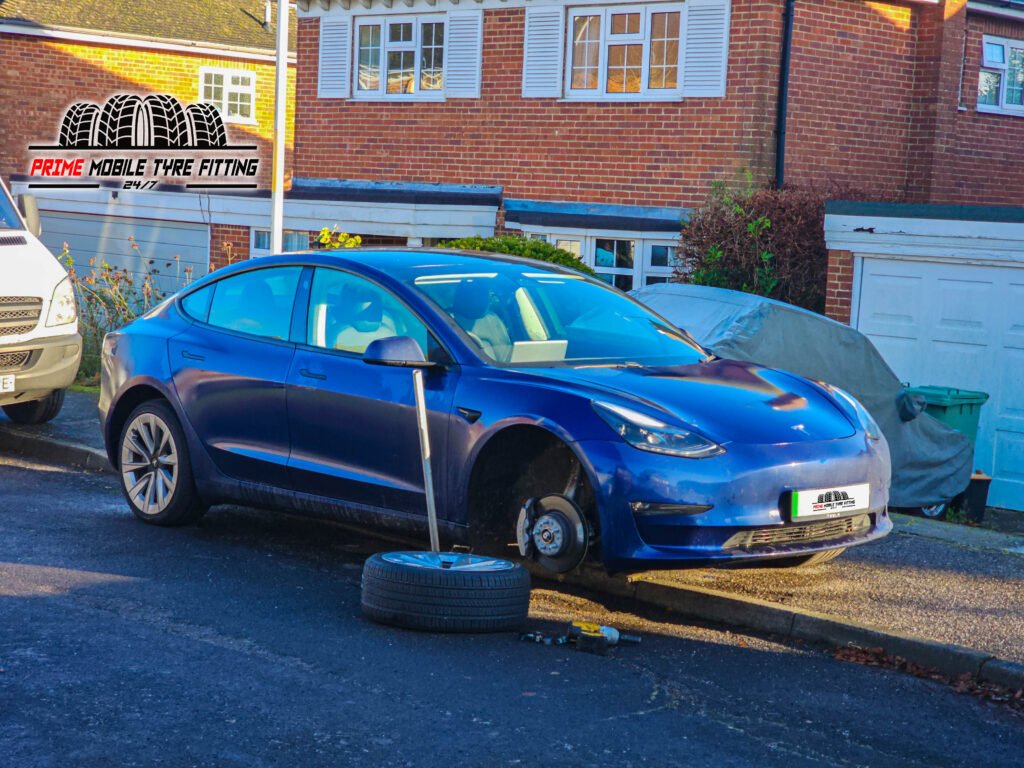
A mobile tyre technician can assess the tyre at your location, fit a replacement where required and help you avoid recovery costs or a wasted day waiting at a tyre depot. Prime Mobile Tyre Fitting brings the tyre shop to you, with the equipment to inspect the problem properly and get you back on the road where it is safe to do so.
The safest decision is not always the cheapest one
Tyre repair legal limits are there to protect you, your passengers and everyone sharing the road. A repair is a sensible, cost-effective answer when the puncture is in the right place and the tyre remains structurally sound. When the damage is in the sidewall, the tyre has been run flat, or there is any doubt about its condition, replacement is the responsible call.
If you are unsure whether your puncture can be repaired, leave the tyre as it is, avoid driving on it and arrange a professional inspection. A clear answer at your location is better than taking a chance with the only part of your vehicle that touches the road.