
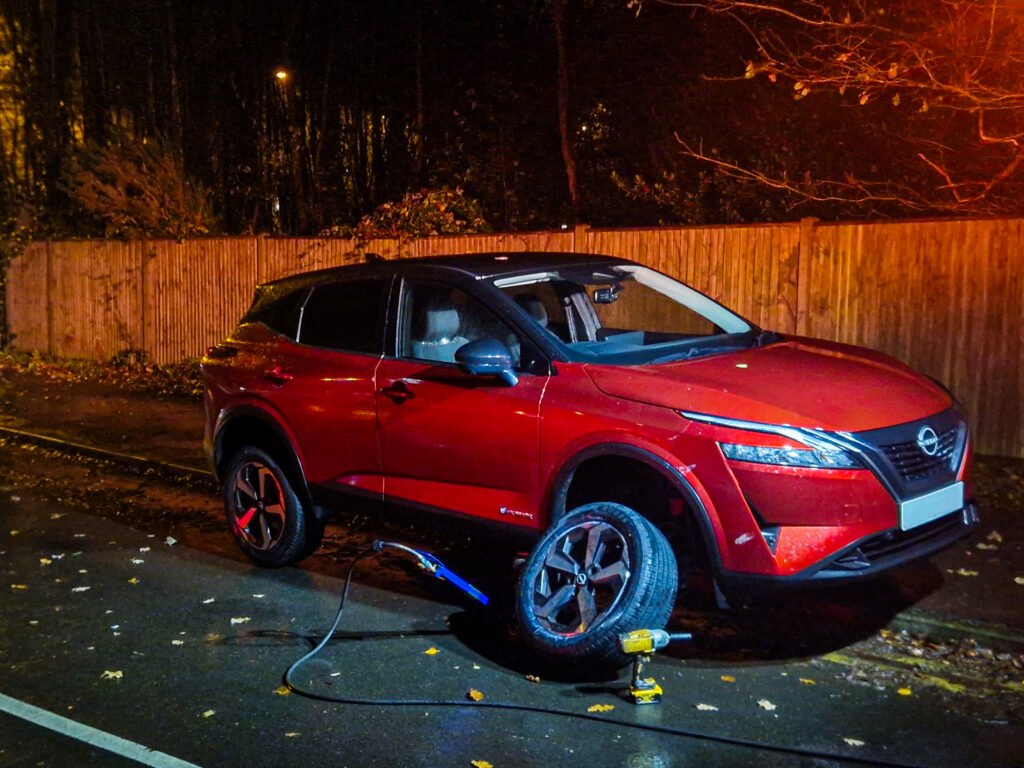
A mobile tyre technician can often get you back on the road far quicker when the car is accessible and the right details are ready. To prepare car for tyre fitting, you do not need mechanical knowledge or a garage full of tools. You simply need a safe place to work, access to the vehicle and a few key items that can prevent avoidable delays.
Whether you have found a nail in a tyre on your drive, suffered a blowout on the way to work or need new tyres fitted at your workplace, a little preparation helps the visit run smoothly. More importantly, it helps keep you, other road users and the technician safe.
Park somewhere safe and level
Where you leave the car matters. Tyres are fitted with professional jacking equipment, so the vehicle needs to be on firm, reasonably level ground. A private driveway, car park bay or clear hard-standing area is usually ideal.
Avoid soft verges, steep slopes, loose gravel and ground that is badly uneven. These surfaces can make it unsafe to lift the car and may mean the technician has to reposition the vehicle before work begins. If your tyre has failed near a busy road, do not attempt to move the car unless it is safe to do so. Put your hazard warning lights on, move yourself and passengers to a safe position away from traffic, and explain your exact location when you call.
Try to leave enough room around the affected side of the vehicle. The technician will need space for the mobile fitting equipment, removed wheels and replacement tyres. If you are on a narrow drive, move bins, bikes, garden furniture or anything else that restricts access if it is safe to do so.
Find the locking wheel nut key before help arrives
This is one of the biggest causes of delay at a tyre fitting. Many cars have locking wheel nuts or bolts fitted to deter wheel theft. They require a matching adaptor, commonly called a locking wheel nut key, before the wheel can be removed.
Check the glovebox, centre console, boot compartments and the toolkit under the boot floor. On some vehicles, the key is kept beside the spare wheel or in a small pouch with the vehicle tools. If you have recently had work carried out, it may have been left in a different compartment.
If you cannot find it, do not worry, but say so when booking. Prime Mobile Tyre Fitting can assess options for locking wheel nut removal, provided it is safe and practical to do so. Telling the technician in advance means they can arrive prepared rather than discovering the issue once the vehicle is raised.
Do not try to force the locking nut off with unsuitable sockets, pliers or a hammer. Damaging the locking nut, wheel or brake components can turn a straightforward tyre job into a more involved repair.
Have the tyre details ready, if you can
You do not have to know your tyre size to arrange mobile fitting. A technician can inspect the vehicle and confirm what is needed. However, providing the markings from the tyre sidewall can speed up tyre supply and ensure the correct specification is brought to you.
Look for a sequence such as 225/45 R17 94W. This identifies the width, profile, construction, wheel diameter, load rating and speed rating. A clear photograph of the sidewall is often the easiest option, particularly if you are at the roadside or do not feel confident reading the numbers.
If you are ordering replacement tyres, also mention whether you have a particular requirement. You may need a like-for-like replacement, a budget-conscious option, premium tyres, reinforced tyres for a van, or seasonal tyres. The right choice depends on the vehicle, how you use it, your mileage and your budget. The cheapest option is not always the best value if it wears quickly or does not suit regular motorway use.
If the damaged tyre is still inflated enough to inspect, tell the technician what has happened. A nail in the central tread area may be repairable, but sidewall damage, a blowout, a tyre driven while flat or damage close to the shoulder will usually require replacement. Never remove a nail or screw before it has been assessed, as it may be slowing the air loss.
Clear the boot and keep the vehicle accessible
If your car has a spare wheel, tyre mobility kit, wheel brace or locking wheel nut key under the boot floor, clear enough space to reach it. You do not need to empty the whole boot, but heavy shopping, luggage, tools or pushchairs can make access difficult.
Keep the keys nearby and make sure the technician can access the vehicle if needed. Some cars store tyre-pressure information in the vehicle settings, while others may need a tyre pressure monitoring system reset after new tyres are fitted. If you are leaving the car at work or with a family member, agree who will be available to unlock it and approve the work.
For company vans and small fleets, it is useful to have the registration number, vehicle location and a contact who can authorise the job. That keeps your driver from waiting around and gets the vehicle earning again sooner.
Do not loosen wheel nuts yourself
It can seem helpful to start the job early, but leave wheel removal to the professional. Wheel nuts must be loosened and tightened using the correct method and torque setting. Over-tightening can damage threads or make future removal difficult. Under-tightening is a serious safety risk.
The same applies to jacking the car up. Use of the wrong jacking point can damage the sill, underbody or battery housing on some electric and hybrid vehicles. A fully equipped mobile tyre technician has the right lifting equipment and knows where the vehicle can be safely supported.
Your part is simple: apply the handbrake, select park or first gear as appropriate, switch off the engine and keep passengers out of the vehicle while work is underway. If you have wheel trims, mention this only if they are loose or damaged. The technician will handle their removal carefully.
Let us know about unusual vehicle details
Most cars and vans up to 3.5 tonnes are straightforward to work on, but a few details are worth flagging at the time of booking. This includes vehicles with very low suspension, aftermarket alloy wheels, run-flat tyres, tyre sealant already in the tyre, modified wheel nuts or a previous puncture repair.
Electric vehicles can be heavier than similar-sized petrol or diesel cars, and some have specific lifting points. That does not prevent mobile tyre fitting, but accurate vehicle information helps ensure the right equipment is used. The same applies to large vans carrying a heavy load. If possible, explain whether the vehicle is loaded and whether access is restricted by height barriers, gates or underground parking.
If the car has been parked for some time after a puncture, check whether the tyre is visibly flattened or the wheel is sitting on the ground. Do not drive on it to move it into a better position. Driving even a short distance on a flat tyre can destroy the internal structure, damage the wheel and remove any chance of a safe repair.
Make roadside fitting safer
A roadside puncture feels urgent, especially when you are late for work, heading to the airport or collecting children. Safety comes first. Pull over as far from moving traffic as conditions allow, avoid stopping on a bend or blind crest, and use hazard warning lights.
On a motorway, do not wait beside the vehicle. Move behind a safety barrier where one is available and contact the appropriate emergency services or road operator if the location is dangerous. Mobile tyre fitting is ideal for many roadside situations, but there are locations where traffic conditions make on-site work unsafe. In those cases, getting the vehicle to a safer place is the right call.
Be ready to share a precise location. A postcode is helpful at home or work, while road names, nearby landmarks, junction numbers and the direction of travel are useful on the road. A dropped map pin can also prevent wasted time searching for the vehicle.
A quick check before the technician arrives
Before the appointment, make sure the car is parked securely, the locking wheel nut key has been located where possible, and the technician has the registration, tyre size or a sidewall photo. Keep pets and children clear of the work area, and let reception, security or neighbours know if access through a gate or private car park is required.
That is all most drivers need to do. Prime Mobile Tyre Fitting brings the tyre shop to you with the tools, tyres and experience to deal with the job properly. A safe space, clear access and the right information give your technician the best chance of getting you moving without delay.
If your tyre is losing pressure now, do not gamble on making one more journey. Park safely, keep the locking wheel nut key handy and arrange help before a minor puncture becomes a bigger roadside problem.